

Connecting Structured Intelligence with Generative AI: Building Europe’s Open Music Observatory
Linking Open Knowledge and Policy Frameworks for Music and Culture
At WikidataCon 2025, Daniel Antal, the Work Package Leader responsible for data infrastructure in the Open Music Europe consortium, presented how Wikibase Suite and Wikidata can strengthen Europe’s digital public infrastructure. These open-source knowledge-management systems are already used by the European Commission, the European Union Intellectual Property Office, and hundreds of cultural institutions in Europe and North America.
By linking open knowledge with authoritative institutional and commercial datasets, the Open Music Observatory directly supports a key policy goal of Open Music Europe: to make cultural and creative data FAIR — findable, accessible, interoperable, and reusable — across domains and sectors. This work operationalises the vision set out in the European Parliament’s 2022 Resolution on the Situation of the European Music Sector, the Music Ecosystem Study (2023), and the Open Data Directive (2019/1024): strengthening Europe’s music ecosystem through transparent, data-driven innovation.
From Silos to Sharing Spaces
Europe’s cultural data landscape remains fragmented. Rights-management databases, library catalogues, audiovisual archives, and streaming services all contain valuable information but rarely interoperate. Using Wikibase Suite, the Open Music Observatory builds data-sharing spaces that connect these systems through shared identifiers, vocabularies, and governance frameworks.
This approach complements the European Strategy for Data and the European Data Space for Cultural Heritage by making it technically feasible to link open-government data, publicly funded research, and business metadata. In the European Union, the Open Data Directive ensures that public-sector and publicly funded data are available for reuse; in the United States and OECD countries, similar frameworks promote access to authoritative public information. By bridging these sources, Open Music Europe demonstrates how policy becomes infrastructure — connecting open science, open government, and corporate data to create an integrated European Data Space for Culture [their server is down, but you can link it].
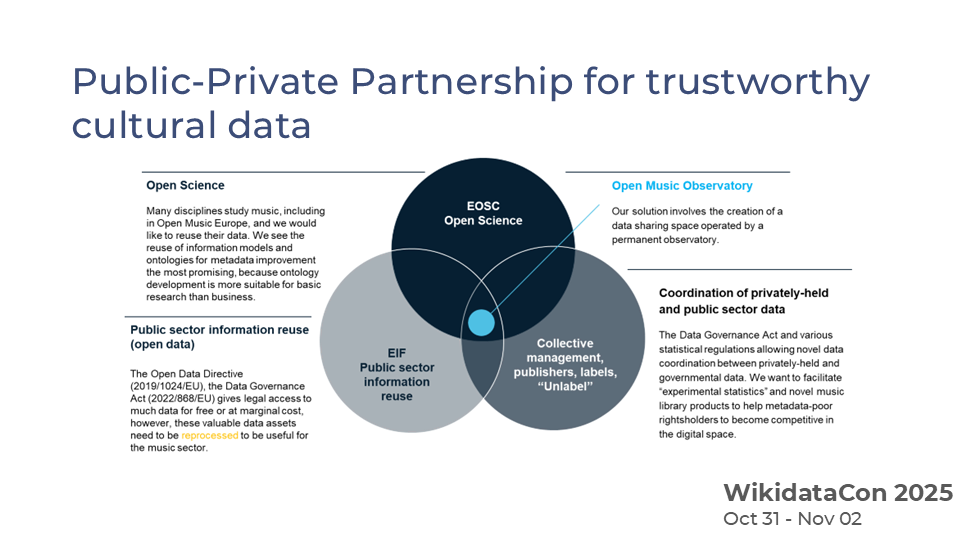
The public–private–partnership model of data interoperability.
Open science contributes research data, open government provides authoritative registries, and private-sector data adds operational and market context. The overlap — the data sharing space — is where cross-domain reuse, verification, and responsible openness take place.
A Staging Area for the Commons
Data-sharing spaces act as staging areas for open cultural data. They allow institutions and companies to prepare their data for responsible release — ensuring legal compliance, contextual integrity, and alignment with rights frameworks before publication to Wikidata or other open graphs.
This practical architecture gives meaning to what the Music Ecosystem Study described as “evidence-based cultural policymaking” — a balance between data protection and data dissemination. Under this model, organisations retain full control of their sensitive or copyrighted content while contributing verified metadata to the Internet of Data, improving overall discoverability and quality.
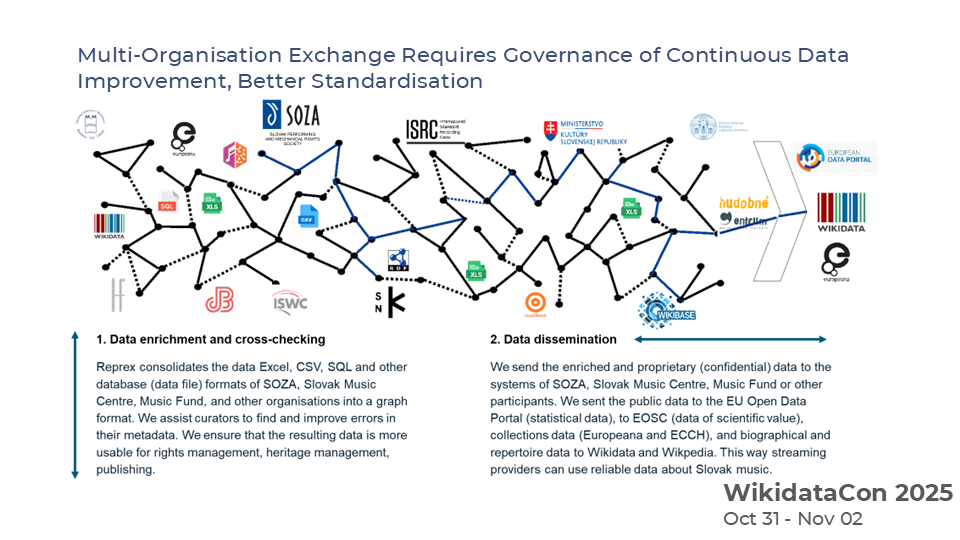
Controlled information flows between organisational databases and open knowledge graphs.
Data-sharing spaces enable two-way enrichment: institutions contribute verified metadata and receive improved contextual data in return, enhancing Europe’s open digital ecosystem.
Amplifying Minority Voices
The Open MusE pilot data-sharing spaces in Slovakia and the Finno-Ugric region show how interoperable infrastructures can preserve diversity and foster inclusion.
From Udmurt folk rock to Mari ethnopunk, these systems document and disseminate previously inaccessible musical heritage, linking community archives to European and global knowledge graphs.
A cornerstone of this work is the Slovak Comprehensive Music Database (SKCMDb), which connects national libraries, collective-management organisations, and streaming platforms. By modelling rights, repertoire, and metadata in a shared Wikibase environment, the SKCMDb illustrates how Open MusE principles scale from policy vision to working infrastructure.
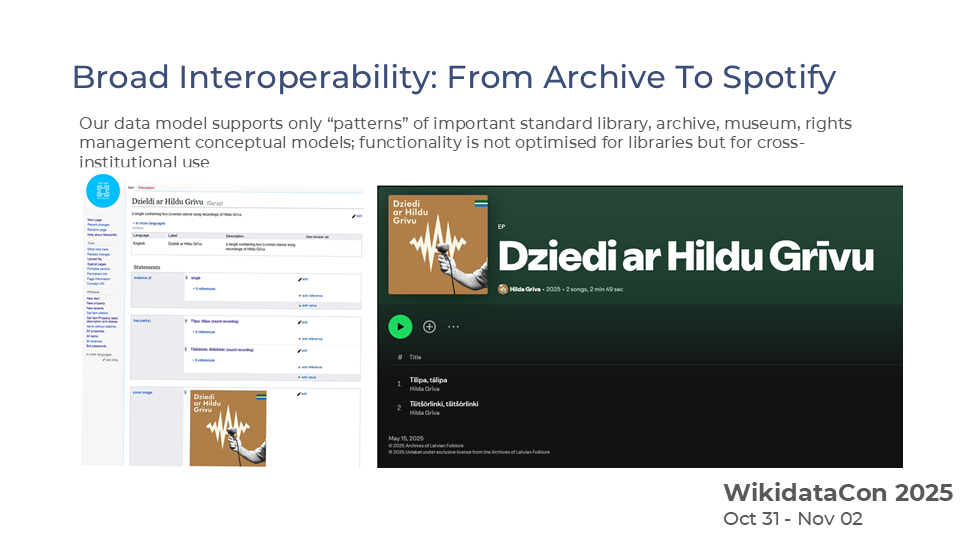
The Hilda Grīva case demonstrates how careful metadata alignment supports both rights management and dissemination.
By reconciling archival, licensing, and streaming datasets, Open MusE partners enabled lawful online publication. The same workflows used in the SKCMDb can inform other national or sectoral initiatives, proving that trustworthy, open cultural data benefits creators, institutions, and audiences alike.
Toward a European Data Space for Culture
The Open Music Observatory contributes directly to implementing the European Data Strategy, the Digital Europe Programme, and Creative Europe Policy Framework.
By making cultural metadata machine-readable and legally interoperable, Open Music Europe advances Europe’s cultural, creative, and technological sovereignty.
Wikibase and Wikidata are not merely technical tools; they are components of a European digital commons that enable trustworthy AI, transparent rights management, and inclusive cultural innovation.
A more technical and business-focused version of this post is available on Reprex’s premium blog, where consortium members provide case studies, practical tips, and masterclasses on adopting truly trustworthy AI workflows for the music industry:
Building the Missing Link Between Reasoning and Generation